Connect Claude to MyCase: cases, contacts, documents, tasks, calendar, calls, time, billing, staff.
Connect Claude to MyCase: cases, contacts, documents, tasks, calendar, calls, time, billing, staff.
mycase-mcp · v1.0.4
by Oktopeak
MyCase MCP Server
Connect Claude to your MyCase legal practice management system. Ask Claude to look up cases, find contacts, check your calendar, review billing — all without leaving your conversation.
Built by Oktopeak.
Demo
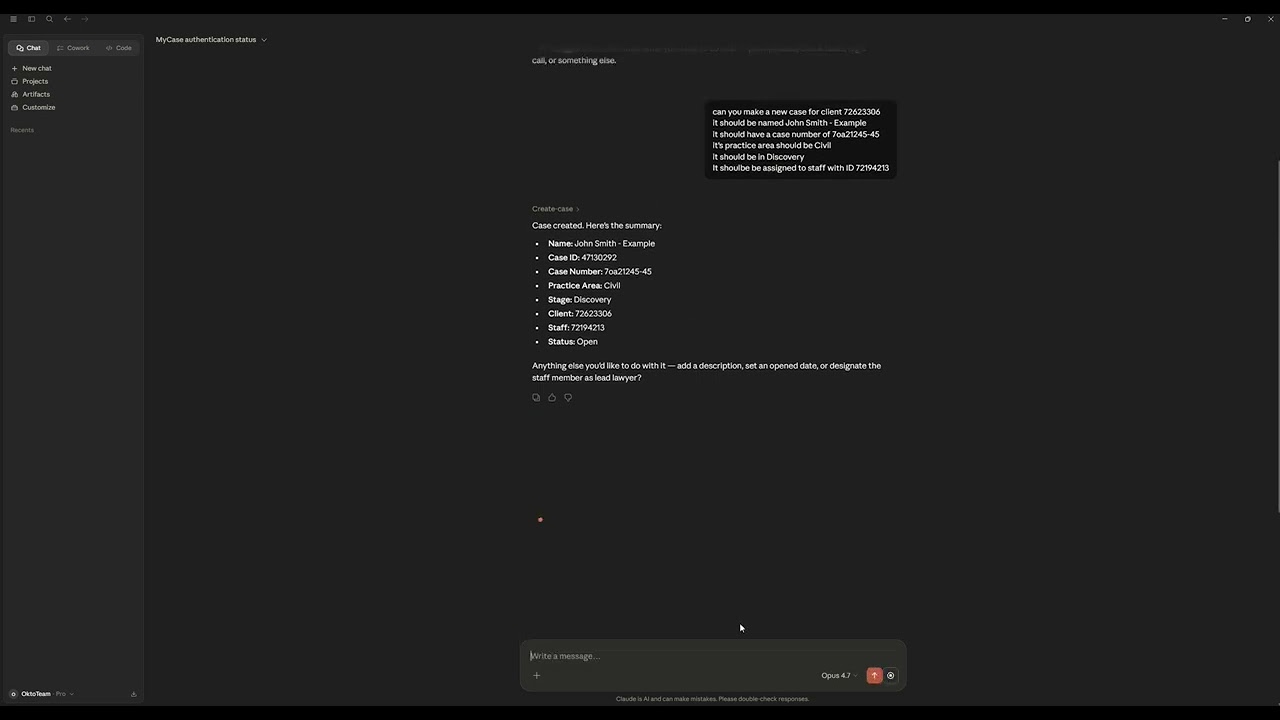
Watch Claude pull live data from MyCase in under a minute — cases, contacts, documents, calendar — without copying client information into chat.
What it does
Once connected, Claude can talk directly to your MyCase firm data. You can ask things like:
- "What open cases do we have for Jane Smith?"
- "Show me all tasks due this week"
- "What's the outstanding balance on the Anderson case?"
- "Log a 20-minute call with client #1234 about the settlement"
- "List documents attached to case 98765"
Everything goes through MyCase's official OAuth 2.0 API. Your credentials never leave your machine — tokens are stored locally, encrypted with AES-256-GCM.
Prerequisites
- Node.js 18+
- A MyCase account with firm admin access
- MyCase API credentials — reach out to MyCase support to request OAuth client credentials for your firm. You'll receive a
client_idandclient_secret.
Installation
With Claude Desktop (recommended)
Add this to your Claude Desktop config file:
macOS: ~/Library/Application Support/Claude/claude_desktop_config.json
Windows: %APPDATA%\Claude\claude_desktop_config.json
{
  "mcpServers": {
    "mycase": {
      "command": "npx",
      "args": ["-y", "@oktopeak/mycase-mcp"],
      "env": {
        "MYCASE_CLIENT_ID": "your_client_id",
        "MYCASE_CLIENT_SECRET": "your_client_secret",
        "ENCRYPTION_KEY": "your_64_char_hex_key"
      }
    }
  }
}
Restart Claude Desktop and you're done.
Standalone / development
npm install -g @oktopeak/mycase-mcp
Generating an encryption key
Your tokens are stored encrypted on disk. You need to generate a random 32-byte key (64 hex characters) and keep it consistent across restarts — if you change it, you'll need to re-authenticate.
node -e "console.log(require('crypto').randomBytes(32).toString('hex'))"
Copy the output and use it as your ENCRYPTION_KEY.
Configuration
If running locally (not via Claude Desktop env vars), copy .env.example to .env and fill it in:
cp .env.example .env
# From MyCase support
MYCASE_CLIENT_ID=your_client_id
MYCASE_CLIENT_SECRET=your_client_secret

# Generated above
ENCRYPTION_KEY=your_64_char_hex_encryption_key

# OAuth callback port (default: 5678)
# Must match the redirect URI registered with MyCase support
MYCASE_REDIRECT_PORT=5678
Note: The redirect URI registered with MyCase support must match
http://127.0.0.1:{MYCASE_REDIRECT_PORT}/callback. If you're unsure which port was registered, check with MyCase support.
Secret handling
MYCASE_CLIENT_SECRET and ENCRYPTION_KEY are sensitive credentials. When passed via claude_desktop_config.json, restrict that file's permissions:
macOS:
chmod 600 ~/Library/Application\ Support/Claude/claude_desktop_config.json
Windows: Right-click the file → Properties → Security → Edit → remove access for all accounts except your own user.
OS keychain integration is planned for a future release.
log-call (experimental)
The log-call tool is gated behind an environment variable while its API endpoint is being verified:
MYCASE_EXPERIMENTAL_TOOLS=1
Add this to your claude_desktop_config.json env block or .env file to enable it. Leave it unset to keep it hidden from Claude.
Authentication
The first time you use it, you need to authenticate with MyCase:
- In Claude, call the
authenticatetool - Your browser will open the MyCase login page
- Log in and grant access
- Return to Claude — you're connected
Access tokens are valid for 24 hours and refresh automatically. Refresh tokens last 2 weeks. Once the refresh token expires you'll need to re-authenticate.
Your encrypted token file lives at ~/.oktopeak-mycase/tokens.enc. To log out and remove it, call the logout tool.
Available tools
Authentication
| Tool | Description |
|---|---|
authenticate |
Open the MyCase OAuth page and store your tokens |
auth-status |
Check if you're connected and when your token expires |
logout |
Remove stored tokens from disk |
Cases
| Tool | Description |
|---|---|
list-cases |
List cases, optionally filtered by status (open/closed) or updated date |
get-case |
Get full details for a case by ID |
create-case |
Create a new case with clients, staff, and metadata |
Contacts
| Tool | Description |
|---|---|
search-contacts |
Search for clients, people, or companies by name, email, or phone |
get-contact |
Get full contact details by ID |
Tasks
| Tool | Description |
|---|---|
list-tasks |
List tasks, optionally filtered by case or completion status |
create-task |
Create a new task linked to a case |
Documents
| Tool | Description |
|---|---|
list-documents |
List documents, optionally filtered by case |
get-document-url |
Get a download URL for a specific document |
Calendar
| Tool | Description |
|---|---|
list-calendar-events |
List upcoming events within a date range |
Calls
| Tool | Description |
|---|---|
log-call |
Log a phone call linked to a case or contact (experimental — requires MYCASE_EXPERIMENTAL_TOOLS=1) |
Staff
| Tool | Description |
|---|---|
list-staff |
List all staff members in the firm |
get-staff |
Get full details for a staff member by ID |
Billing
| Tool | Description |
|---|---|
list-time-entries |
List billable time entries, filtered by case or date range |
get-billing-summary |
Get total billed, outstanding, and paid amounts for a case |
A note on multi-user support
This server is single-tenant by design — it stores one set of credentials at a time and is intended for a single firm running it locally. If you authenticate as a different user, the previous token is overwritten.
If you need multiple firms or users, you'd need to run separate instances with separate configurations.
Development
git clone https://github.com/oktopeak/mycase-mcp.git
cd mycase-mcp
npm install
cp .env.example .env   # fill in your credentials
npm run build
npm run inspect        # opens the MCP inspector in your browser
Running tests
npm test               # run once
npm run test:watch     # watch mode
Security
- OAuth tokens are encrypted at rest using AES-256-GCM
- The
ENCRYPTION_KEYnever leaves your machine - Token and audit log files are stored in
~/.oktopeak-mycase/with mode0600(owner-read/write only) on Unix/macOS - On Windows, restrict
%APPDATA%\.oktopeak-mycasevia folder Properties → Security - All API calls go directly from your machine to
external-integrations.mycase.com
Vulnerability scan
npm audit --omit=dev reports 0 production vulnerabilities. The vitest dev-dependency carries 5 moderate findings (esbuild, vite) that are unreachable in production and require a major vitest version bump to resolve. They have no impact on deployed server instances.
License
MIT — see LICENSE.
Built with the Model Context Protocol SDK by Anthropic.